
Brasil · June 2026
Safety in Brazil for Expats 2026
Atlas da Violência and Anuário de Segurança Pública data by state, safe cities for foreigners, risk zones, and practical advice for everyday life
Safety in Brazil is one of the most discussed topics among prospective expats. The key fact: "Brazil" doesn't exist as a single entity in this sense — it's a continental country of 26 states plus the Federal District with radically different conditions. Florianópolis (Santa Catarina) ranks as the safest state capital, while some Northern and Northeastern cities have homicide rates several times higher.
Official data comes from two main sources: the Atlas da Violência (published by IPEA and the Fórum Brasileiro de Segurança Pública) and the Anuário Brasileiro de Segurança Pública — both released annually with detailed breakdowns by state and capital. The good news for 2025: Brazil recorded about 34,000 homicides, down from 38,374 in 2024, continuing a downward trend that began in 2020.
The vast majority of foreigners living in Brazil — in São Paulo, Florianópolis, Curitiba, Rio de Janeiro, Belo Horizonte, and other expat-popular cities — lead normal lives. The dominant risk for foreigners is not violence but petty theft, especially phone snatching. Reasonable caution, knowledge of your specific neighborhood, and common sense significantly reduce risks.
Key Facts
| National homicide rate (2024) | ~20 per 100,000 | Down ~25% since 2020; ~34,000 homicides in 2025 |
| Safest state | São Paulo / Santa Catarina | Around 8 per 100,000 — lowest in the country |
| Safest cities for expats | Florianópolis, Curitiba, São Paulo (good areas) | Based on Atlas da Violência data and expat community assessments |
| Uniformity of safety levels | Low | Conditions vary significantly between regions and even neighborhoods |
| US State Dept level (overall) | Level 2 (Exercise Increased Caution) | Favelas are Level 4 "Do Not Travel" at all times |
| Highest-risk areas | Favelas, North/Northeast capitals | Amapá, Bahia, Ceará lead state homicide rates |
| Crime against foreigners | Predominantly petty theft | Phone snatching is the dominant street crime |
| Phone theft share (São Paulo) | ~87% of robberies | Peaks between 4 PM and 9 PM |
Safety Overview
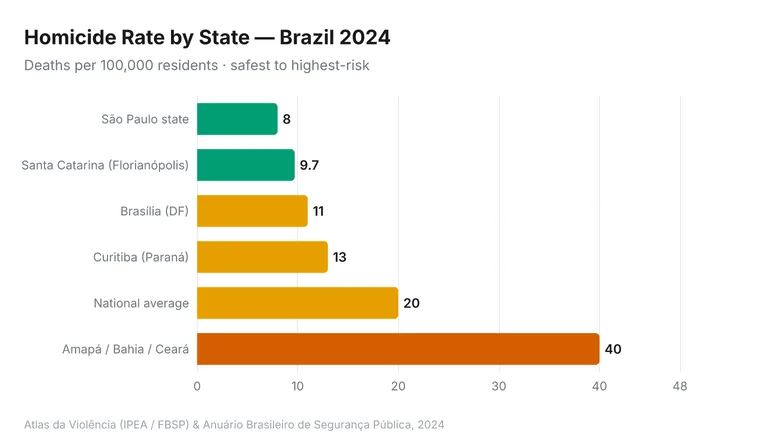
Brazil faces serious security challenges, primarily linked to organized crime, drug trafficking, and high inequality in large urban peripheries. However, lethal violence is heavily concentrated geographically and demographically — it predominantly affects young men in specific neighborhoods, and rarely reaches foreign expats living in established central areas. The national homicide rate sat around 20 per 100,000 in 2024, but ranges from roughly 8 in São Paulo and Santa Catarina to 40+ in states like Amapá and Bahia.
The 2025 Anuário Brasileiro de Segurança Pública confirmed that violent deaths fell again, with about 34,000 homicides recorded in 2025 versus 38,374 in 2024. For everyday foreigners, the far more common threat is property crime: pickpocketing, bag theft, and above all phone snatching. In São Paulo, phone theft accounts for roughly 87% of robberies and peaks in the late afternoon and evening.
For an expat choosing where to live in Brazil, the key advice is to research the specific city and neighborhood, not the country as a whole. The safety gap between Florianópolis and a Northeastern capital is comparable to the gap between two entirely different countries.
Safety Rankings by State
The Atlas da Violência and the Anuário Brasileiro de Segurança Pública publish annual homicide data for each state. Below are consolidated safety groupings based on 2024 data and US State Department assessments. Within each state, conditions can vary significantly between the capital, the interior, and urban peripheries — always research the specific locality.
| Level | States / regions | Notes |
|---|---|---|
| Safer (low homicide rate) | São Paulo, Santa Catarina, Distrito Federal, Minas Gerais (parts), Paraná | South and Southeast; recommended for expat residence |
| Moderate | Rio de Janeiro, Goiás, Rio Grande do Sul, Espírito Santo | Safe in central areas; some zones require caution |
| Exercise caution | Mato Grosso, Pará, Maranhão, Amazonas (Manaus area) | Capitals generally manageable; peripheries with caution |
| High risk (highest homicide rates) | Amapá, Bahia, Ceará, Pernambuco, Alagoas | Northern/Northeastern states with elevated violence |
Safe Cities for Expats
Several Brazilian cities consistently enjoy a reputation for relative safety among both locals and foreigners. This is confirmed by Atlas da Violência data (low homicide rates) and reports from established expat and digital-nomad communities.
Florianópolis (Santa Catarina)
Florianópolis is the safest state capital in Brazil, with a homicide rate of about 9.7 per 100,000 in 2024 — less than half the national average. The island city combines beaches, a strong quality of life, and a thriving tech scene, and it is widely considered the leading digital-nomad destination in the country. The surrounding state of Santa Catarina is consistently among the safest in Brazil.
Curitiba (Paraná)
The capital of Paraná, Curitiba is one of the safest large cities in Brazil (around 13 per 100,000 in 2024) and is known for urban planning, public transport, and a high standard of living. It is popular with families and professionals seeking a calmer alternative to São Paulo and Rio while keeping big-city amenities.
São Paulo (good neighborhoods)
São Paulo state has one of the lowest homicide rates in the country (around 8 per 100,000), and the capital reached its lowest robbery rate in 25 years in 2025. Affluent, well-policed neighborhoods such as Jardins, Itaim Bibi, Vila Madalena, Pinheiros, and Moema are popular with expats and are comfortable by day. The main everyday risk is phone snatching, which rises after dark.
Brasília (Distrito Federal)
The federal capital has a relatively low homicide rate (about 11 per 100,000) and the central Plano Piloto area is calm and orderly. As with other Brazilian cities, the satellite towns on the periphery vary widely, and standard urban caution applies. It suits expats tied to government, diplomacy, or institutions.
Belo Horizonte (Minas Gerais)
The capital of Minas Gerais is a major economic hub with a reputation for friendly residents and good food. Central neighborhoods like Savassi and Lourdes are comfortable for expats. As elsewhere, safety is hyperlocal: central zones are fine, while some peripheral districts require more caution.
Safety in São Paulo and Rio de Janeiro
São Paulo is a megalopolis of over 12 million people in the city and around 22 million in the metro area. Like any major world city, safety varies dramatically by neighborhood. Popular expat zones — Jardins, Itaim Bibi, Pinheiros, Vila Madalena, Moema — are comfortable for daily life by day. The dominant street threat is phone snatching, which intensifies after roughly 8:30 PM. Daytime, from about 7 AM to dusk, is the safest window for walking.
Rio de Janeiro is more visually striking and more uneven. The South Zone tourist neighborhoods — Ipanema, Leblon, Copacabana, Barra da Tijuca — are busy and well-lit, and risks there relate mostly to petty theft rather than violence. Ipanema is often considered the safest part of the city for foreigners. Favelas, however, are designated Level 4 "Do Not Travel" by the US State Department and should not be entered, even on guided tours.
Practical statistics: in both cities, app-based taxis (Uber, 99, InDriver) are significantly safer than hailing a cab on the street and are standard among expats. ATM-related "express kidnappings" — short-term abductions forcing victims to withdraw cash — occur but are uncommon for residents who use ATMs inside banks and malls.
| Safety level | Example neighborhoods |
|---|---|
| High (recommended) | SP: Jardins, Itaim Bibi, Moema · Rio: Ipanema, Leblon, Barra da Tijuca |
| Good (standard caution) | SP: Pinheiros, Vila Madalena, Brooklin · Rio: Copacabana, Botafogo |
| Variable (research specific block) | SP: Centro, República, Bela Vista · Rio: Centro, Santa Teresa, Lapa at night |
| Avoid (for foreigners) | Favelas and informal settlements in both cities (Level 4) |
High-Risk Areas
Several types of areas in Brazil require heightened caution or should be avoided entirely. The US State Department and other foreign ministries publish regularly updated warnings — these are the key official reference points.
The clearest rule is favelas (also called comunidades or aglomerados): the US State Department designates all informal housing developments as Level 4 "Do Not Travel" at all times, including on guided tours, because neither tour operators nor police can guarantee safety inside them. Beyond favelas, the August 2025 advisory also flags certain suburbs at night and wide stretches of Brazil's land borders, particularly remote frontier zones tied to trafficking routes.
At the regional level, the highest homicide rates are concentrated in Northern and Northeastern states — Amapá, Bahia, Ceará, Pernambuco, and Alagoas led the 2024 rankings. Tourist hubs within these states (for example historic Salvador or coastal resorts) can be visited with care, but peripheral neighborhoods and travel after dark warrant extra caution.
Practical Tips
Transportation: use app-based services (Uber, 99, InDriver) rather than hailing taxis on the street, and avoid walking with your phone out, especially after dark. Drive during daylight when possible, keep windows up and doors locked in traffic, and never leave valuables visible in the car.
Phone safety: phone snatching is the single most common street crime in Brazil, so avoid using your smartphone on the street unnecessarily — especially while walking, waiting for transport, or in crowds. Enable a SIM PIN and remote-wipe, and consider a cheaper "street phone" for navigation. Brazilians increasingly rely on Pix payments, which reduces the need to carry cash or cards.
Cash and ATMs: don't display large amounts of cash. Withdraw money from ATMs inside banks, shopping malls, or well-lit areas — not from street-facing machines, ideally during daylight. Check the ATM for skimmers, cover the keypad, and limit how much you withdraw at once. Beware PIX QR-code swap scams and unsolicited "free tour" offers that end at an ATM.
Support network: join local expat communities (Facebook groups, Internations, neighborhood WhatsApp chats) — you can get first-hand information about the current situation in specific areas. Register with your embassy's traveler program (such as the US State Department's STEP) for official security alerts.
Emergency numbers and documents: memorize the key numbers — 190 (Military Police), 192 (SAMU ambulance), and 193 (Fire Department / Bombeiros). Carry a copy of your passport and your CRNM/visa, not the original, and keep emergency contacts (embassy, local services) accessible at home.
Frequently Asked Questions
How safe is Brazil for expats compared to other Latin American countries?
Brazil falls roughly in the middle to upper range of the regional homicide ranking — safer than Venezuela or Honduras, but with more lethal violence than Chile, Uruguay, or Argentina. The specific city matters most: Florianópolis, Curitiba, and good São Paulo neighborhoods are far safer than the national average and comparable to many mid-sized world cities.
Can expats travel freely throughout Brazil?
In most regions — yes, with reasonable precautions. The main tourist and expat circuits (São Paulo, Rio South Zone, Florianópolis, Curitiba, Iguaçu) are well-established and manageable. However, favelas should never be entered, some Northern and Northeastern peripheries warrant extra care, and remote land-border zones can be risky. Always check current US State Department and your own foreign ministry advisories before unfamiliar travel.
Are São Paulo and Rio de Janeiro safe for expats?
Yes, in the right neighborhoods. In São Paulo, areas like Jardins, Itaim Bibi, and Pinheiros host large expat communities and are comfortable by day. In Rio, the South Zone — Ipanema, Leblon, Copacabana — is busy and well-policed. Standard urban caution applies: use app taxis, avoid late-night walks in unfamiliar areas, and keep your phone out of sight on the street.
Is it true that crime in Brazil is falling?
Yes. Both the Atlas da Violência and the Anuário Brasileiro de Segurança Pública show a sustained decline since 2020 — homicides dropped roughly 25% over that period, and 2025 recorded about 34,000 homicides versus 38,374 in 2024. São Paulo even reached its lowest robbery rate in 25 years in 2025. Phone theft is also gradually declining nationally.
Why are favelas considered so dangerous for foreigners?
Favelas are informal settlements often controlled by drug-trafficking factions or militias, where police operations can occur with little warning. The US State Department designates all of them Level 4 "Do Not Travel" at all times, including guided tours, because neither tour operators nor police can guarantee a foreigner's safety inside. Stray bullets and sudden shootouts are the main risks. Stay out of them entirely.
What is the biggest everyday safety risk for foreigners in Brazil?
Phone snatching, by a wide margin. In São Paulo it accounts for around 87% of robberies and peaks between 4 PM and 9 PM. Thieves on foot or motorbike grab phones from people walking or sitting at cafés. Keep your phone out of sight on the street, use a cheaper device for navigation, and enable a SIM PIN and remote wipe so a stolen phone is useless.
What are the emergency numbers in Brazil?
The three main numbers are 190 for the Military Police (Polícia Militar), 192 for the SAMU ambulance service, and 193 for the Fire Department (Corpo de Bombeiros). Both 190 and 192 work from any phone, including without credit. Save them in your phone and learn enough Portuguese to give your location, since English-speaking operators are not guaranteed.
Should I register with my embassy when moving to Brazil?
Strongly recommended. The US State Department's STEP (Smart Traveler Enrollment Program) and equivalents from other embassies let you receive current security alerts and stay in contact with the consulate in emergencies — evacuations, natural disasters, or personal crises. Registration takes about 5 minutes online and is free.
Sources
| Source | Description | Accessed |
|---|---|---|
| Atlas da Violência (IPEA / FBSP) | Annual atlas of violence — official homicide data by state and capital | June 2026 |
| Fórum Brasileiro de Segurança Pública — Anuário | Brazilian Public Security Yearbook — national crime statistics | June 2026 |
| UNODC — Homicide Statistics | UNODC — international homicide data by country and region | June 2026 |
| US State Department — Travel Advisory Brazil | US State Department travel advisory and caution areas for Brazil | June 2026 |
| Global Peace Index — Brazil | Global Peace Index — Brazil's ranking and comparative analysis | June 2026 |
| Numbeo Crime Index — Brazil Cities | Crowdsourced crime level data for Brazilian cities | June 2026 |
| US Embassy in Brazil — Travel Advisory & Caution Maps | US citizen safety guidance and caution-area maps for Brazil | June 2026 |
The safety situation changes — check current US State Department and your home country's foreign ministry advisories before traveling. Homicide figures reflect the 2024 Atlas da Violência and 2025 Anuário data.