
Brasil · Updated May 2026
Cost of Living in Brazil 2026
Complete guide for expats, remote workers, and entrepreneurs — with real numbers, official sources, and budget examples for four cities
Brazil is Latin America's largest economy and the fifth-largest country in the world by area: a continental nation of 27 states stretching from the Amazon rainforest to the temperate south. Greater São Paulo holds over 22 million people, making it the largest metropolitan area in the Southern Hemisphere. Brazilian cities combine vibrant culture, world-renowned cuisine, and, for many foreigners earning in dollars or euros, monthly costs well below those in North America or Western Europe.
The cost of living varies enormously by city. São Paulo and Rio de Janeiro — the two best-known destinations — command the highest rents and approach the prices of mid-tier European cities in their most fashionable neighbourhoods. Meanwhile, Florianópolis and Curitiba in the south offer a high quality of life at substantially lower cost. A single digital nomad in Curitiba can live comfortably on $800–$1,100 per month, while a professional couple in São Paulo's trendiest districts typically spends $2,000–$3,200. The spread between cities is one of the widest in the region.
This guide draws on May 2026 data from Brazil's Instituto Brasileiro de Geografia e Estatística (IBGE), the IPCA consumer price index, Banco Central do Brasil exchange rates, and listing databases such as QuintoAndar and Numbeo. All USD figures use a reference rate of 5.5 BRL = 1 USD, approximating the Banco Central mid-market rate as of May 2026. Housing price ranges reflect typical advertised rents in each city's expat-favoured neighbourhoods.
Key Monthly Costs at a Glance
| Rent, 1-bedroom, São Paulo (Jardins/Pinheiros, premium) | $520–$760 | Unfurnished, excluding condomínio |
| Rent, 1-bedroom, Rio de Janeiro (Zona Sul) | $450–$720 | Unfurnished, excluding condomínio |
| Rent, 1-bedroom, Florianópolis (centre/beaches) | $330–$640 | Unfurnished, excluding condomínio |
| Rent, 1-bedroom, Curitiba (Centro/Batel) | $300–$500 | Unfurnished, excluding condomínio |
| Groceries (1 person, cooking at home) | $180–$280 | |
| São Paulo Metro, single trip | $0.98 | |
| Utilities: electricity + water + internet (1-BR) | $70–$110 | |
| Comfortable single budget total (Curitiba) | $800–$1,100 | |
| Comfortable couple budget total (São Paulo) | $1,800–$2,800 |
Quick Overview
Brazil uses the Brazilian real (BRL, symbol R$). As of May 2026, the Banco Central do Brasil reference rate is approximately 5.5 BRL per US dollar. The real has been volatile in recent years, driven by fiscal concerns and the central bank's interest-rate cycle; the IBGE's IPCA index reported annual inflation of around 4.5% in early 2026, near the upper limit of the central bank's target band.
The national minimum wage is R$1,621 per month (approximately $295) as of January 2026, set by federal decree and adjusted annually for inflation plus real GDP growth. The average formal-sector wage across Brazil is roughly R$3,000–R$3,500 per month ($545–$636), though qualified professionals in São Paulo and Rio earn considerably more. Brazil has high payroll taxes and a complex labour code, which keeps formal wages and consumer prices elevated relative to neighbouring countries.
For foreign residents, the key financial consideration is currency risk: the real can swing significantly against the dollar and euro. Most long-term expats keep savings or income in USD and convert as needed. Another factor: imported goods — cars, electronics, branded clothing — are very expensive due to Brazil's high import tariffs and the so-called custo Brasil (the cost of doing business). Everyday groceries, local services, and dining out, however, remain affordable for dollar earners.
Housing & Rent
Housing is the largest expense for most Brazil expats. Unlike Uruguay, where one city dominates, Brazil's most popular expat destinations differ radically in price and character. São Paulo is the business and cultural capital; Rio de Janeiro offers beaches and an iconic lifestyle at a tourist premium; Florianópolis and Curitiba in the south are increasingly favoured by digital nomads and families for their safety, climate, and lower costs.
Lease terms are typically 30 months, denominated in reais, though shorter contracts are common in the rental-platform era. Most rentals require either a fiador (a guarantor who owns property in Brazil), a seguro-fiança (rent-guarantee insurance, roughly 10–15% of annual rent), or a caução (deposit of up to three months' rent). A major budgeting trap is the condomínio — monthly building fees that cover security, cleaning, and amenities, often R$400–R$1,500 ($73–$273) on top of rent — plus the annual IPTU property tax. Most rentals are unfurnished; furnished apartments carry a 20–40% premium.
São Paulo — Jardins, Pinheiros, Vila Madalena
São Paulo's most desirable neighbourhoods attract international professionals, executives, and the creative class. Jardins is the city's upscale district of designer shops and fine dining; Pinheiros and Vila Madalena offer a lively bar scene, coworking spaces, and a strong digital-nomad presence; Itaim Bibi is the financial hub. The city has excellent restaurants, world-class cultural venues, and the densest job market in the country, but traffic and the cost of central housing are significant.
| Apartment type | Monthly rent (USD) |
|---|---|
| Studio (kitnet) | $360–$580 |
| 1-bedroom | $520–$900 |
| 2-bedroom | $760–$1,400 |
| 3-bedroom | $1,200–$2,400 |
Rio de Janeiro — Copacabana, Ipanema, Botafogo
Rio's Zona Sul (South Zone) is the heart of the expat and lifestyle scene: Copacabana and Ipanema offer beachfront living at a premium, while Botafogo and Flamengo are slightly more affordable with excellent metro access. Leblon is the most expensive neighbourhood in the country. Rio combines an unmatched setting with real trade-offs — pockets of insecurity, summer heat, and prices that have risen sharply in tourist-favoured areas.
| Apartment type | Monthly rent (USD) |
|---|---|
| Studio (conjugado) | $320–$540 |
| 1-bedroom | $450–$820 |
| 2-bedroom | $680–$1,300 |
| 3-bedroom | $1,100–$2,200 |
Florianópolis — Centro, Lagoa da Conceição, Campeche
The capital of Santa Catarina state — known affectionately as Floripa — has become one of South America's premier digital-nomad destinations. It combines 40-plus beaches, one of Brazil's highest human-development indexes, and a thriving tech sector. Lagoa da Conceição is the heart of the nomad scene; Centro is more urban and connected; Campeche and the south of the island attract surfers and families. Prices spike sharply during the December–February summer high season.
| Apartment type | Monthly rent (USD) |
|---|---|
| Studio | $270–$450 |
| 1-bedroom | $330–$640 |
| 2-bedroom | $500–$950 |
| 3-bedroom | $760–$1,500 |
Curitiba — Centro, Batel, Água Verde
The capital of Paraná is consistently ranked among Brazil's best-planned and safest large cities, with a celebrated bus-rapid-transit network and a cool, temperate climate. Batel is the upscale district of restaurants and nightlife; Água Verde and Centro offer good value with strong connectivity. Curitiba is more affordable than São Paulo or Rio and appeals to families and remote workers who prioritise safety, green space, and quality of life over beaches and nightlife.
| Apartment type | Monthly rent (USD) |
|---|---|
| Studio | $220–$380 |
| 1-bedroom | $300–$500 |
| 2-bedroom | $450–$780 |
| 3-bedroom | $680–$1,200 |
| City / Neighbourhood | Studio | 1-bedroom | 2-bedroom |
|---|---|---|---|
| São Paulo — Jardins/Pinheiros | $360–$580 | $520–$900 | $760–$1,400 |
| Rio de Janeiro — Zona Sul | $320–$540 | $450–$820 | $680–$1,300 |
| Florianópolis — Lagoa/Centro | $270–$450 | $330–$640 | $500–$950 |
| Curitiba — Batel/Centro | $220–$380 | $300–$500 | $450–$780 |
Groceries & Food
Brazil is an agricultural powerhouse — a leading global exporter of beef, chicken, soy, coffee, and tropical fruit — so domestically produced food is generally affordable. The main supermarket chains are Carrefour, Grupo Pão de Açúcar (GPA), Assaí, and Atacadão (cash-and-carry, the cheapest option). Neighbourhood feiras (open-air street markets) and sacolões offer the best prices on fresh produce. IBGE tracks food prices monthly within the IPCA index.
The table below reflects May 2026 prices from IBGE's IPCA basket and Numbeo São Paulo data, converted at 5.5 BRL/USD. These are mid-range supermarket prices; cash-and-carry stores like Atacadão and weekly feiras can cut produce costs by 20–40%.
Dining Out
Brazil's everyday dining culture offers good value, especially the ubiquitous self-service buffet billed by weight (comida por quilo) and the fixed-price lunch (prato feito). A weekday lunch at a por-quilo restaurant costs R$30–R$55 ($5.45–$10). A casual dinner at an inexpensive restaurant runs about R$45 ($8.18) per person. A specialty cappuccino in São Paulo or Floripa costs R$10–R$15 ($1.82–$2.73), and a domestic draft beer (chope) at a bar is R$10–R$15.
A three-course dinner for two at a mid-range restaurant in São Paulo or Rio runs R$200–R$350 ($36–$64). Delivery apps (iFood dominates, with Rappi and Uber Eats also present) add service and delivery fees but are available in every city. Tipping is not obligatory; restaurants usually add a 10% service charge (taxa de serviço) to the bill.
| Item | Price (BRL) | Price (USD) |
|---|---|---|
| White bread, 500 g | R$9.80 | $1.78 |
| Whole milk, 1 L | R$6.00 | $1.09 |
| Eggs, 12 units | R$14.50 | $2.64 |
| Chicken fillet, 1 kg | R$26.90 | $4.89 |
| Beef (round), 1 kg | R$56.00 | $10.18 |
| White rice, 1 kg | R$7.10 | $1.29 |
| Black beans, 1 kg | R$9.50 | $1.73 |
| Tomatoes, 1 kg | R$9.50 | $1.73 |
| Potatoes, 1 kg | R$7.25 | $1.32 |
| Bananas, 1 kg | R$6.50 | $1.18 |
| Local cheese, 1 kg | R$45.00 | $8.18 |
| Ground coffee, 500 g | R$22.00 | $4.00 |
| Domestic beer (0.5 L bottle) | R$7.50 | $1.36 |
| Mineral water, 1.5 L | R$4.70 | $0.85 |
| Household | Budget range (USD) | Notes |
|---|---|---|
| Single person (home cooking) | $180–$280 | Basic basket, cooking Brazilian food |
| Couple (mostly home cooking) | $320–$460 | Includes some convenience items |
| Family of 3 (2 adults + child) | $430–$620 | Full basket, some dining out |
Transport
São Paulo has the most extensive rail network in Brazil — a Metro of six lines plus the CPTM commuter rail, integrated through the Bilhete Único smart card. A single metro or train trip costs R$5.40 ($0.98) as of January 2026, and the Bilhete Único allows bus-to-rail transfers within a time window for a single integrated fare. A daily commuter in São Paulo typically spends R$240–R$320/month ($44–$58) on the monthly transit pass and integrated fares.
Rio de Janeiro has a smaller two-line Metro (single fare around R$7.10, $1.29) plus buses and the iconic VLT light rail downtown. Curitiba is famous for its Rede Integrada de Transporte (RIT) bus-rapid-transit system, with a flat fare of about R$6.00 ($1.09). Florianópolis is more car- and bus-dependent, as the city spreads across an island. Uber, 99 (locally dominant), and InDrive operate in all four cities; a typical 5 km urban ride costs R$15–R$30 ($2.73–$5.45).
Petrol (gasolina comum) costs approximately R$6.20 per litre ($1.13). Brazil has a large domestic auto industry and a unique ethanol fuel market — many cars are flex-fuel and run on cheaper sugarcane ethanol. Second-hand cars hold their value well and are relatively expensive: a 3–5 year-old economy car typically costs R$55,000–R$110,000 ($10,000–$20,000).
Owning a Car in São Paulo
Car ownership in São Paulo carries significant costs beyond fuel: the rodízio (a weekday driving restriction by licence-plate number during rush hours in the expanded centre), expensive paid parking ($5–$12/day in central districts), the annual IPVA vehicle tax (roughly 4% of the car's value in São Paulo state), mandatory insurance, and high maintenance costs. Monthly car-ownership costs in São Paulo — fuel, insurance, parking, IPVA, maintenance — run $250–$450 for a modest vehicle. Many residents in central São Paulo and Rio manage without a car, relying on the Metro and ride-hailing apps.
| Mode / City | Cost |
|---|---|
| São Paulo Metro/CPTM, single trip | R$5.40 ($0.98) |
| São Paulo monthly transit pass | R$240–R$320 ($44–$58) |
| Rio de Janeiro Metro, single trip | R$7.10 ($1.29) |
| Curitiba RIT bus, single trip | R$6.00 ($1.09) |
| Uber/99, avg city trip 5 km | R$15–R$30 ($2.73–$5.45) |
| Petrol, per litre (gasolina comum) | R$6.20 ($1.13) |
| Taxi, per km | R$5.00 ($0.91) |
| Monthly car costs (mid-range vehicle, São Paulo) | $250–$450 |
Utilities & Internet
Brazil's utility market is a mix of regional concessionaires for electricity (Enel, CPFL, Light, Copel) and water (Sabesp in São Paulo, Cedae in Rio), plus competitive private internet and mobile providers led by Vivo, Claro, TIM, and Oi. Brazil has some of the highest electricity tariffs in the world, driven by heavy taxation and a tariff-flag system (bandeiras tarifárias) that raises prices when reservoirs are low and thermal plants must run.
Electricity for a 1-bedroom apartment runs R$120–R$280/month ($22–$51) with moderate use, but bills climb sharply in hot regions where air conditioning runs much of the year — in Rio or the northeast, summer bills can hit R$400–R$700 ($73–$127). The biggest utility surprise for newcomers is the condomínio fee, which on apartment buildings often bundles water, building security, and amenities into a single monthly charge of R$400–R$1,500 ($73–$273).
Internet and Mobile
Fibre broadband coverage is excellent in major Brazilian cities, and Brazil ranks among Latin America's leaders in fixed-internet speed. Vivo Fibra and Claro offer 300–500 Mbps plans for R$90–R$150/month ($16–$27); regional providers often undercut the majors with even cheaper fibre. São Paulo, Florianópolis, and Belo Horizonte have particularly dense coworking ecosystems with reliable high-speed connections.
Mobile service is competitive and inexpensive. Vivo (Telefónica), Claro (América Móvil), and TIM compete nationwide; a postpaid plan with unlimited calls and ample data costs R$45–R$80/month ($8–$15). Prepaid (pré-pago) SIM cards are cheap and widely available, but registration requires a CPF (Brazilian tax ID), which arrivals should obtain early as it is needed for almost every contract and purchase.
| Service | Provider | Typical monthly cost |
|---|---|---|
| Electricity (moderate use, no AC) | Enel/CPFL/Light | R$120–R$280 ($22–$51) |
| Electricity (with AC, Rio/northeast) | Enel/Light | R$400–R$700 ($73–$127) |
| Water + sewerage | Sabesp/Cedae | R$80–R$160 ($15–$29) |
| Cooking gas (botijão 13 kg) | Ultragaz/Liquigás | R$110–R$140 ($20–$25) |
| Internet 300 Mbps fibre | Vivo/Claro | R$90–R$130 ($16–$24) |
| Mobile plan (unlimited calls + data) | Vivo/Claro/TIM | R$45–R$80 ($8–$15) |
| Total (electricity + water + internet, no AC) | — | $53–$104 |
Healthcare
Brazil has a universal public healthcare system, the SUS (Sistema Único de Saúde), which provides free care to everyone in the country — including foreigners and tourists — funded by taxation. It is one of the largest public health systems in the world and handles everything from primary care and vaccinations to complex surgery and organ transplants at no cost at the point of use.
Quality and wait times in the SUS vary widely by region and facility. Because of crowding and long waits for non-urgent care, most middle-class Brazilians and nearly all expats carry private health insurance (plano de saúde) and use the country's extensive network of private hospitals and clinics — including internationally accredited centres such as Hospital Israelita Albert Einstein and Hospital Sírio-Libanês in São Paulo, which offer world-class care.
The Public System (SUS)
The SUS is free and universal: no enrollment fee, no residency requirement, and no charge for consultations, hospitalisation, or medication on the public formulary. Emergency rooms (pronto-socorro) treat anyone who arrives. This is a genuine safety net that distinguishes Brazil from many of its neighbours.
The practical limitation is capacity: SUS facilities are heavily overloaded in large cities, with long waits for specialists, diagnostic imaging, and elective procedures. Many expats register with the SUS for emergencies while using private insurance and clinics for routine and specialist care to avoid the queues.
| Aspect | SUS (public) | Private (plano de saúde) |
|---|---|---|
| Cost | Free at point of use | R$200–R$1,500/mo ($36–$273) |
| Wait times | Long for non-urgent | Short, scheduled |
| Coverage | Universal, all residents | Per plan tier |
Private Insurance and Out-of-Pocket Care
A private health plan (plano de saúde) from operators such as Bradesco Saúde, SulAmérica, Amil, or Unimed costs roughly R$200–R$500/month ($36–$91) for a young adult on a basic regional plan, rising to R$700–R$1,500/month ($127–$273) for comprehensive national coverage or for older applicants. International expat policies from Cigna Global or Allianz Care valid in Brazil run $100–$280/month depending on age and tier.
Out-of-pocket costs at private clinics are moderate by North American or European standards: a general consultation costs R$200–R$400 ($36–$73), and a specialist visit R$300–R$600 ($55–$109). Brazil also has popular low-cost pharmacy chains (Droga Raia, Drogasil, Pague Menos), and many medications cost far less than in the United States, with generics widely available.
Three Realistic Monthly Budget Examples
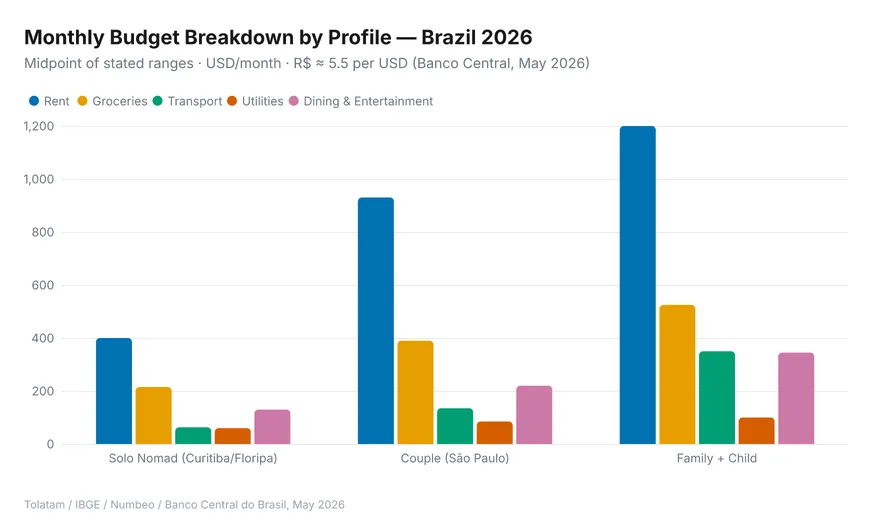
Solo digital nomad
Single remote worker, living alone in Curitiba (Batel/Água Verde) or Florianópolis (Centro)
- Rent (1-bedroom, Batel/Centro) $350–$450
- Condomínio + IPTU (prorated) $80–$140
- Groceries (home cooking, basic basket) $180–$250
- Transport (RIT + occasional Uber) $45–$80
- Utilities (electricity + water + gas) $45–$75
- Internet 300 Mbps + mobile plan $25–$40
- Health (basic plano de saúde) $40–$70
- Entertainment, café, subscriptions $100–$160
Curitiba and Florianópolis offer the best value for money in southern Brazil. The same lifestyle in São Paulo Jardins or Rio Zona Sul would cost $300–$600 more per month.
Professional couple
Two adults, working professionals or digital nomads, 2-bedroom in São Paulo (Pinheiros/Vila Madalena)
- Rent (2-bedroom, Pinheiros) $760–$1,100
- Condomínio + IPTU (prorated) $130–$260
- Groceries (2 persons, mixed shopping) $320–$460
- Transport (transit passes + Uber) $100–$170
- Utilities (electricity + water + gas) $60–$110
- Internet + 2 × mobile $35–$60
- Health (2 × plano de saúde) $90–$200
- Dining out (4–6 times/month) $160–$280
- Entertainment + gym + subscriptions $120–$180
São Paulo offers the broadest job market and cultural scene but the highest condomínio fees in the country. A comparable lifestyle in Curitiba would cost roughly $400–$700 less per month.
Family with one child
Two adults and one school-age child, 2–3 bedroom in São Paulo or Curitiba (family-friendly districts)
- Rent (2–3 bedroom, family district) $900–$1,500
- Condomínio + IPTU (prorated) $150–$320
- Groceries (family of 3) $430–$620
- Transport (1 car monthly costs) $250–$450
- Utilities (electricity + water + gas) $70–$130
- Internet + 2 × mobile $35–$60
- Health (family plano de saúde) $250–$500
- Child: school + activities + supplies $300–$900
- Dining out (2–3 times/month) $90–$170
- Entertainment + clothing + misc $150–$280
Private bilingual schools in São Paulo range from $400 (modest) to $2,000+ (elite international schools) per month. Public schools are free but instruction is in Portuguese. The range above assumes a mid-tier private school.
Frequently Asked Questions
Is Brazil cheaper than the United States or Europe to live in?
For dollar or euro earners, yes — significantly in most categories. Groceries cost 40–55% less than in comparable US cities, rent in good neighbourhoods is a fraction of US coastal-city prices, and private healthcare is far cheaper. The major exceptions are imported electronics, cars, and branded goods, which are often more expensive than in the US or Europe because of Brazil's high import tariffs. Expats with foreign-currency income generally find Brazil very affordable.
Can I live comfortably in São Paulo on $1,500 per month?
A single person can live comfortably — but not lavishly — in São Paulo on $1,500/month in a mid-range neighbourhood like Pinheiros or Vila Mariana. That covers a 1-bedroom at $550–$700 plus condomínio, groceries at $230, transport at $55, utilities at $70, internet and mobile at $35, a basic health plan at $60, and leaves a few hundred dollars for dining out and leisure. In Jardins or central Rio it would be tight, while in Curitiba or Florianópolis $1,500 affords an excellent lifestyle.
What is the cheapest major city for expats in Brazil?
Among the popular expat destinations, Curitiba is the most affordable large city, with a comfortable single lifestyle costing $800–$1,100/month. Florianópolis is similarly priced outside the December–February summer peak. Belo Horizonte and Porto Alegre also offer good value with full big-city amenities, while smaller southern and interior cities are cheaper still — though international flight connections and English-speaking services are more limited there.
How does the rental process work for foreigners in Brazil?
Foreigners can rent freely in Brazil, but landlords usually require one of three guarantees: a fiador (a guarantor who owns property in Brazil), seguro-fiança (rent-guarantee insurance costing about 10–15% of annual rent), or a caução deposit of up to three months' rent. You will also need a CPF (Brazilian tax ID) to sign almost any contract — obtain one early. Rental platforms like QuintoAndar and short-term furnished rentals make the initial search easier and often waive the fiador requirement.
Is healthcare good for foreigners in Brazil?
Brazil has both a free universal public system (SUS) that covers everyone, including foreigners, and a large private sector with internationally accredited hospitals such as Albert Einstein and Sírio-Libanês in São Paulo. The SUS is a genuine safety net but suffers long waits for non-urgent care, so most expats carry private insurance (plano de saúde) starting around R$200–R$500/month ($36–$91) for a young adult and use private clinics for routine and specialist care.
Why are electricity and imported goods so expensive in Brazil?
Brazil has some of the world's highest electricity tariffs, driven by heavy taxation and a tariff-flag system (bandeiras tarifárias) that raises rates when reservoirs are low and costly thermal plants run. Imported goods are expensive because of high import duties and the broader custo Brasil — the elevated cost of doing business from taxes, bureaucracy, and logistics. As a result, cars, electronics, and branded clothing often cost more than in the US, while locally produced food and services stay cheap.
Is Brazil safe for expats?
Safety in Brazil is highly location-specific. The expat-favoured neighbourhoods of São Paulo (Jardins, Pinheiros, Itaim), Rio's Zona Sul, and most of Curitiba and Florianópolis are reasonably safe with normal urban precautions, and Curitiba and Floripa rank among Brazil's safest large cities. However, property crime and street robbery are real concerns in big cities, so expats are advised to research specific neighbourhoods, avoid displaying valuables, and use ride-hailing apps at night rather than walking unfamiliar areas.
How does São Paulo compare to other major Latin American cities on cost of living?
According to the Numbeo Cost of Living Index 2026, São Paulo is broadly comparable to Mexico City and Santiago de Chile, and noticeably more expensive than Bogotá or Lima for housing and dining. Its standout advantages are scale and depth: São Paulo offers the largest job market, the most cultural venues and restaurants, and the widest range of direct international flights of any city in South America, which many professionals consider worth the premium.
Sources
| Source | Description | Accessed |
|---|---|---|
| IBGE | Instituto Brasileiro de Geografia e Estatística — IPCA consumer price index, household budget surveys, income data | May 2026 |
| Banco Central do Brasil | Central bank — official exchange rates, inflation statistics, monetary policy | May 2026 |
| Numbeo | Crowd-sourced cost-of-living database — São Paulo, Rio, Florianópolis, Curitiba prices | May 2026 |
| Metrô de São Paulo | Companhia do Metropolitano de São Paulo — metro fares and Bilhete Único information | May 2026 |
| Agência Brasil | Official government news agency — minimum wage decree and economic indicators | May 2026 |
| ANS | Agência Nacional de Saúde Suplementar — private health insurance regulation and pricing | May 2026 |
| QuintoAndar | Major rental platform — advertised rents across Brazilian cities | May 2026 |
| Global Citizen Solutions | Expat guide — cost-of-living overview and budgeting for Brazil | May 2026 |
All USD figures use a reference exchange rate of 5.5 BRL = 1 USD (Banco Central do Brasil mid-market rate, May 2026). Rents exclude the monthly condomínio fee and annual IPTU property tax, which can add substantially to housing costs. Electricity bills in hot regions may be much higher due to air conditioning. Prices are indicative and subject to change. Always verify current rates before making financial decisions.